
English Version
Das Modell nimmt mich mehr in Anspruch als gedacht. Nicht im negativen Sinn, sondern fast ausschließlich das Gegenteil. Als begeisterungsfähiger Modellbauer schafft dieses Modell eine grandiose Basis. Die Liste der geplanten Modifikationen wächst beständig. Das hat weniger mit der verbauten Technik, als den vielen Details zu tun. Ich habe mich da gerade in eine Herausforderung gestürzt, das mit dem bereits geschafften mehr als ebenbürtig ist. So weit ist es aber heute noch nicht.
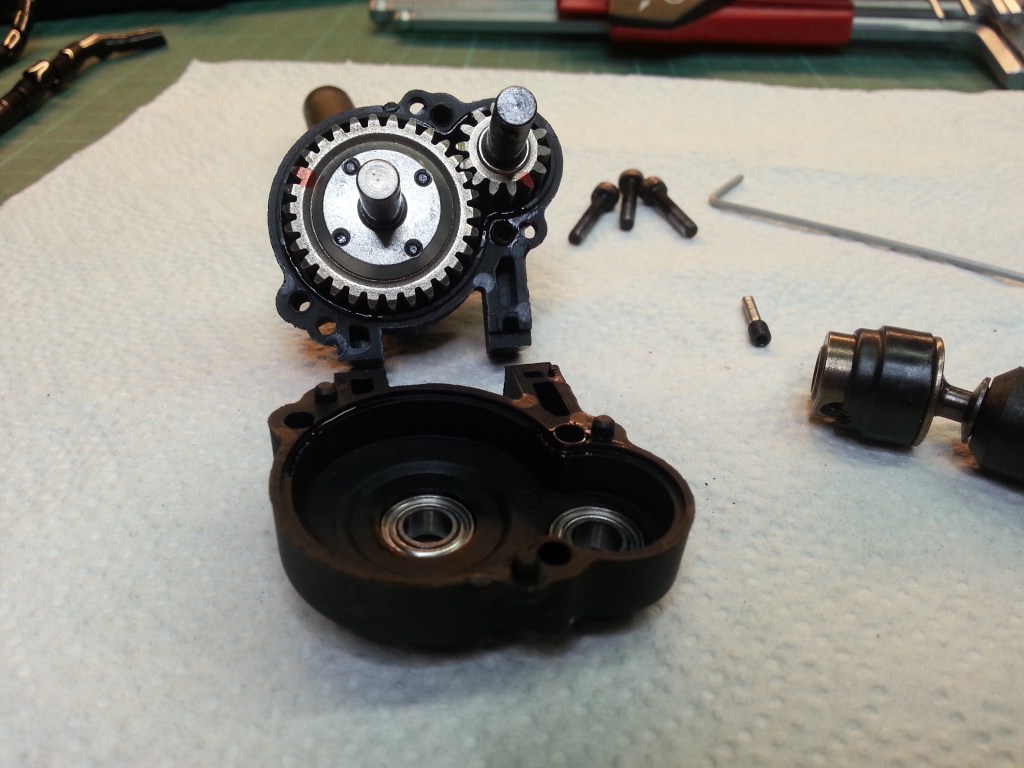
Zuerst noch etwas zu den verbauten Komponenten. Das Verteilergetriebe und die Radachsen. Zwei Wellen und je ein 14- und 30-Zähne-Ritzel, verteilen das Drehmoment auf die beiden Achsen.
Sie wird an den Kegelrädern zu den Antriebsachsen umgeleitet. Das Kegelrad hat dabei 8 Zähne und das Kellerrad 30 Zähne. Wie sonst, auch hier alles voll kugelgelagert!
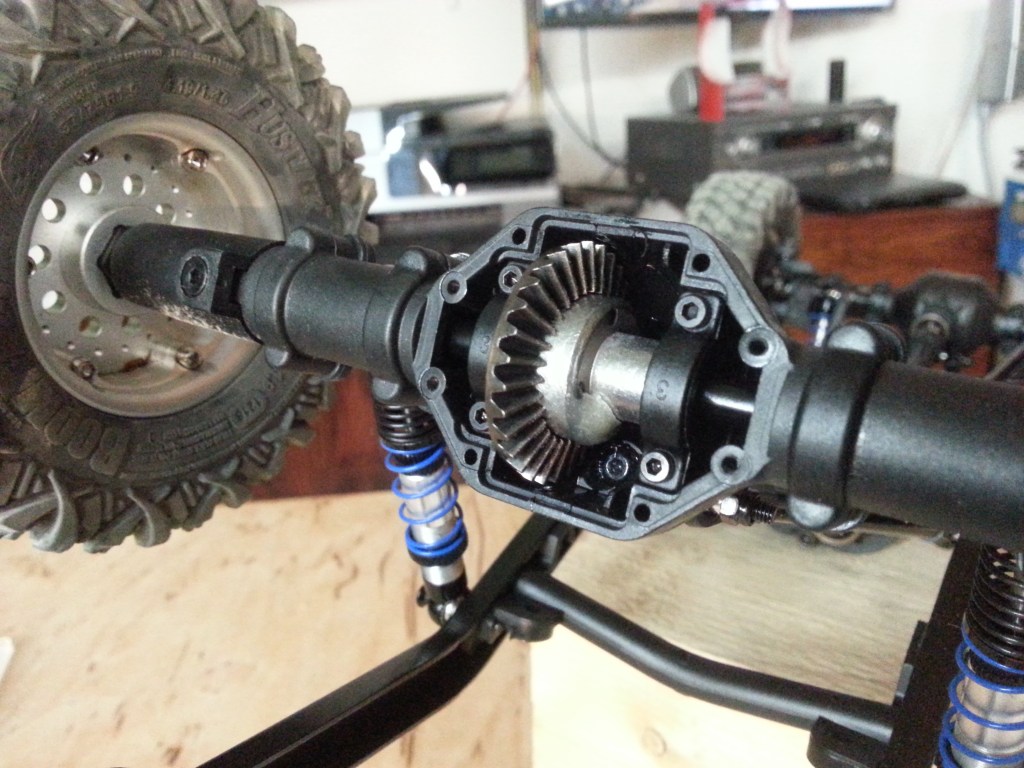
Der erste Eindruck beim Zerlegen und auch beim Fahren war eher positiv. Sehr geringes Flankenspiel und keine Laufgeräusche erforderten zunächst, außer einer Fettpackung, keine Maßnahmen. Zur Abrundung der zum Fahren erforderlichen Elektronik gab es noch ein neues kugelgelagertes Lenkservo mit Metallgetriebe.
Somit ist das Fahrgestell jetzt bereit.
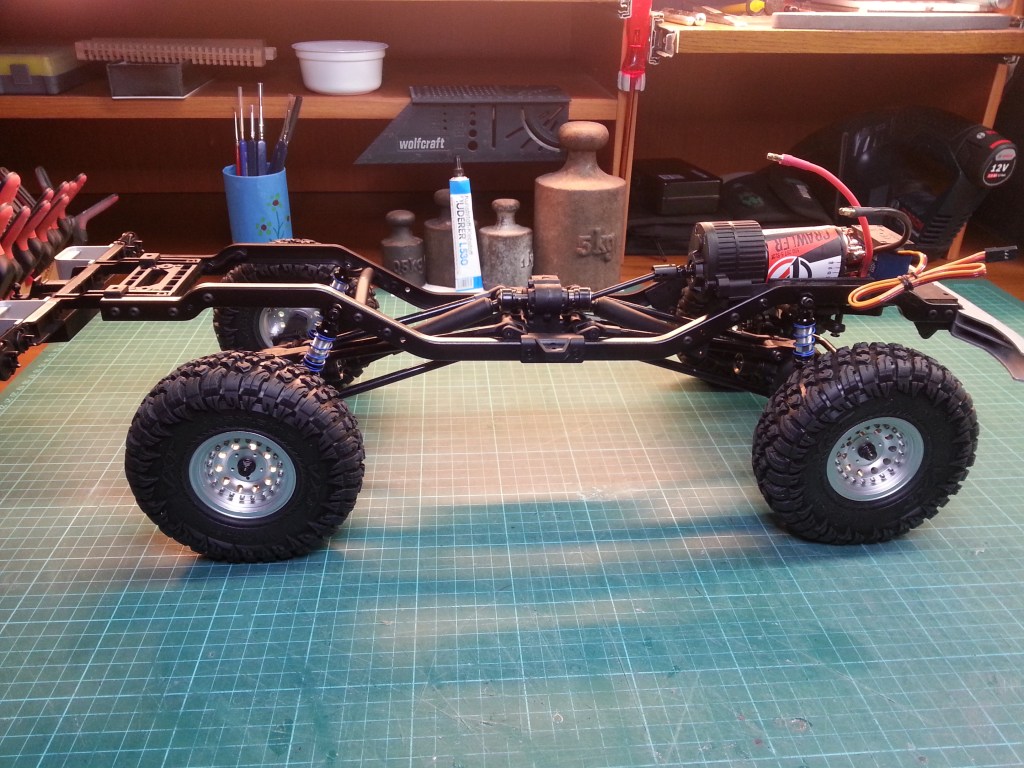
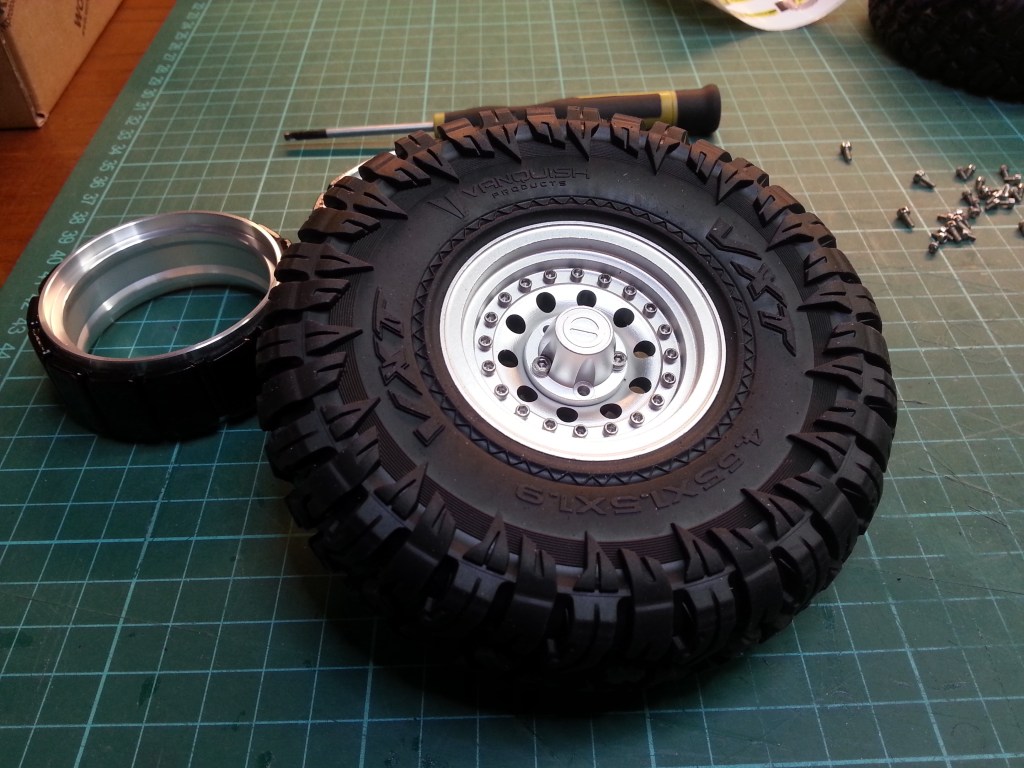
Ein neuer Reifensatz wurde ebenfalls angeschafft. Er ist auf dem Bild bereits montiert. Vanquish VXT in der Größe 4.65 x 1.5 x 1.9 waren meine Wahl. Schmäler als die bisherigen Varianten, dafür etwas größer. Exakt 118 mm im Durchmesser und 38 mm breit. Einerseits stehen die Räder nur noch hinten etwas aus dem Radkasten über und anderseits ist so die Optik insgesamt harmonischer. Bei extremer Verschränkung schleifen die Reifen auch nicht an der Karosserie. Vorne ist jetzt ein völliger Freilauf sichergestellt, lediglich hinten könnte noch geringer Kontakt an der Innenseite der Kotflügel möglich sein.
Für die Montage wurde wieder auf die bewährten Reifeneinlagen A.L.T.-Foams der Fa. RC.HP gesetzt.
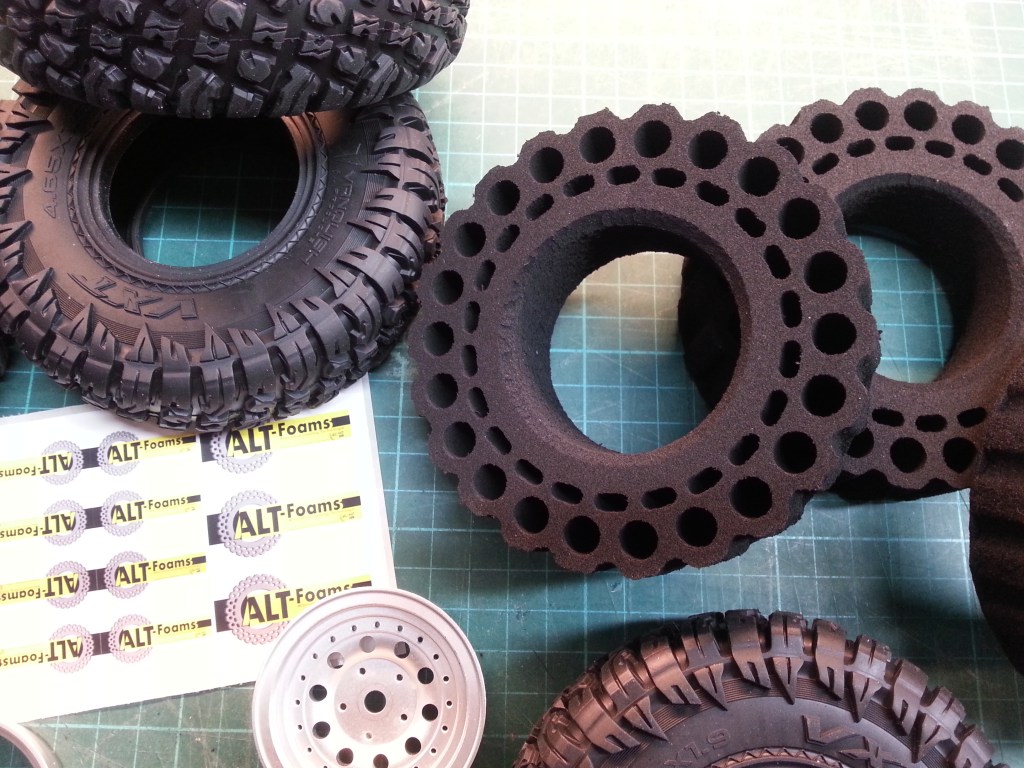
Erstmals gab es bei der Montage auch Zusatzgewicht im Felgenring, um den Schwerpunkt abzusenken. Der Schwerpunkt des Fahrzeuges ist recht hoch und neigt daher zum Kippen. Klebegewichte erhöhten das Gewicht je Rad um 74 Gramm. Mit einem Gesamtgewicht von 255 Gramm je Rad hoffe ich so die Kippneigung zu verbessern.
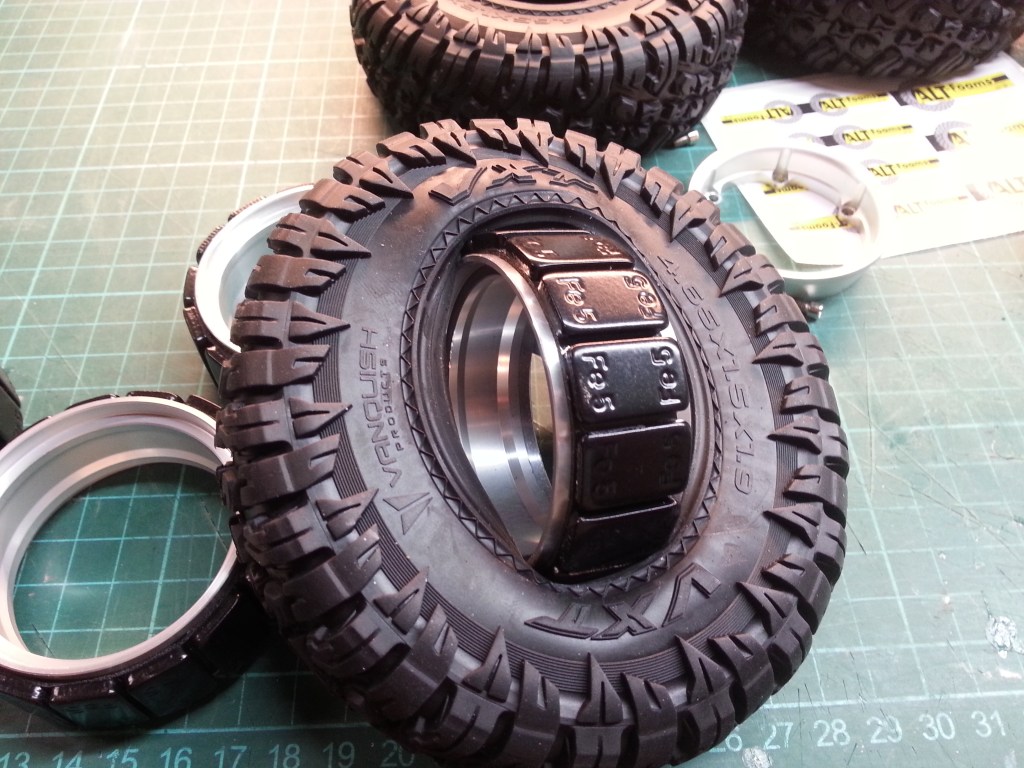
Die Details der Felge…
Im folgenden Beitrag zeige ich meine ersten Umbauten an der Karosserie. Dann mit weniger Technik aber dafür mehr Optik.
Wird schnellstmöglich fortgesetzt…
English Version
Drive technology of the FMS Toyota FJ40
The model is taking up more of my time than I thought. Not in a negative sense, but almost entirely the opposite. As an enthusiastic model builder, this model creates a fantastic basis. The list of planned modifications is constantly growing. This has less to do with the built-in technology than with the many details. I have just thrown myself into a challenge that is more than on a par with what I have already achieved. But I haven’t got that far yet.
First of all, a little about the components installed. The transfer case and the wheel axles. Two shafts and a 14- and 30-tooth pinion each distribute the torque to the two axles.
It is diverted to the drive axles at the bevel gears. The bevel gear has 8 teeth and the ring gear has 30 teeth. As usual, everything is fully ball-bearing mounted!
The first impression when dismantling and also when driving was rather positive. Very little backlash and no running noises initially required no action apart from a grease pack. To round off the electronics required for driving, there was also a new ball-bearing steering servo with metal gears.
The chassis is now ready.
A new set of tires was also purchased. They are already fitted in the picture. Vanquish VXT in the size 4.65 x 1.5 x 1.9 were my choice. Narrower than the previous versions, but slightly larger. Exactly 118 mm in diameter and 38 mm wide. On the one hand, the wheels only protrude slightly from the wheel arch at the rear and on the other, the overall look is more harmonious. The tires do not rub against the bodywork even with extreme articulation. Complete freewheeling is now ensured at the front; only at the rear could there still be slight contact on the inside of the mudguards.
The tried and tested A.L.T. foam tire inserts from RC-HP were again used for mounting.
For the first time, there was also additional weight in the rim ring to lower the center of gravity. The vehicle’s center of gravity is quite high and therefore tends to tip over. Adhesive weights increased the weight of each wheel by 74 grams. With a total weight of 255 grams per wheel, I hope to improve the tendency to tip.
The details of the rim…
In the following article I show my first modifications to the bodywork. Then with less technology but more optics.
Will be continued as soon as possible…
Translation, with the kind support of deepl.com
 RC Crawler Modellbaublog