
Quellen:
English Version
In meiner letzten Vorstellung des Toyota FJ40, konnten erste Eindrücke des fahrfertigen Modells gesammelt werden. Vielen werden sich jetzt vielleicht die Frage zu Vor-, oder Nachteilen eines Fertigmodells stellen. Bisher hatte ich zumindest, Modelle nur als Bausatz gekauft und dann nach eigenen Vorstellungen, mehr oder weniger modifiziert. Den Vorteil sehe ich darin, möglichst nur haltbare und ausschließlich den eigenen Vorstellungen entsprechende Teile zu verbauen. Etwas, was bei einem fahrfertigen Modell nur bedingt der Fall ist. Die Gegenüberstellung von Preis und Leistung wird ein Hauptaugenmerk sein. Dies betrifft sowohl Hersteller, als auch Kunden. Am Beispiel des Toyota versuche ich daher einmal diese berechtigte Frage zu beleuchten.
In den letzten Jahrzehnten hat sich der Grad der Miniaturisierung stark entwickelt. Gleichzeitig haben die daraus resultierenden Möglichkeiten, realitätsnahe Optiken zu schaffen, höchste Maßstäbe erreicht. Im Vergleich zu meiner Anfangszeit, haben sich die Preise für Fernsteuertechniken, in für jedermann erschwinglich Preisbereiche abgesenkt. So niedrig, dass selbst kleinste Modelle direkt mit einer Fernsteuerung ausgestattet werden. Nicht immer ist das dabei Gebotene, mit der an sie gestellten Erwartung im Einklang.
Bei Crawlern steht das langsam fahren im Vordergrund. Gefühlvollste Rangier- und Fahrmanöver sind wichtig für das Gesamtvergnügen. Der Motor hat dabei seine Bedeutung, ist aber nicht die Schlüsselstelle. Allergrößte Bedeutung hat dabei der Fahrtregler. Der verbaute WP-1040-Fahrtregler, wird hier in Deutschland im Preisbereich von ca. 20-30€ gehandelt. Das aktuelle Referenzmodell der WP-1080 hingegen für ca. 40-50€. Der Preisaufschlag wäre also wohl für viele Modellbauer eher kein Thema. Berücksichtigt man noch die Vielzahl der Optimierungsmöglichkeiten beim 1080, dürfte es eigentlich keinen 1040 mehr am Markt geben! Warum also doch? Die beiden Kontrahenten sind nachfolgend zu sehen. Oben der WP-1040, darunter der WP-1080. Rein äußerlich nahezu keine gravierenden Unterschiede, nimmt man die montierten Rundstecker (blau und gelbes Kabel) zum Motor einmal davon aus. Beim Neukauf sind hier meist nur offene Kabelenden zur Selbstkonfektion der Steckervariante vorhanden. Manche verlöten sogar diese Kabel direkt mit den Kontakten am Motor. Das verringert die Übergangswiderstände auf ein Minimum.

Dieses Teil macht den Unterschied…
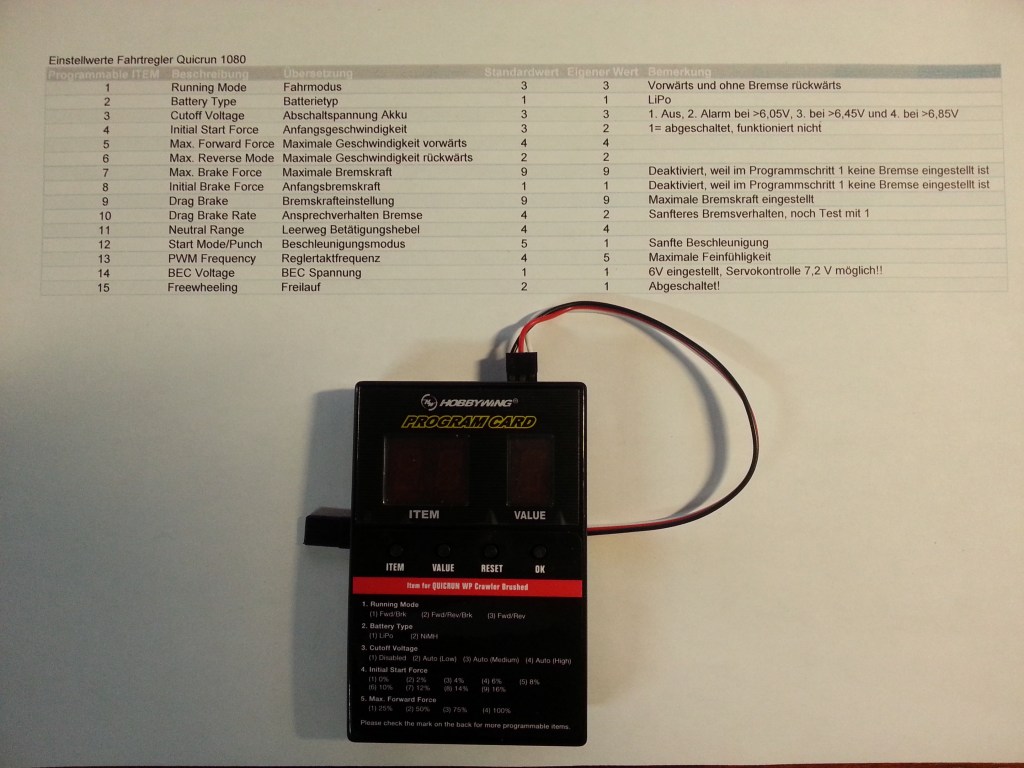
Eine Programmierkarte, die an den Fahrtregler angesteckt wird. Dadurch sind 15 Einstellmöglichkeiten (Item) frei editierbar. Im Hintergrund meine derzeit aktuell gewählte Konfiguration.
Die ersten Fahrten mit dem Standardregler und -motor sahen so aus. Denn Gashebel langsam anziehen. Auf den ersten 5-10 mm, keine erkennbare Reaktion des Motors. Danach setzt sich das Auto mehr oder weniger stark in Bewegung. Die Dosierbarkeit ist grenzwertig, bis explosiv. Das gefühlvolle Fahren ähnelt so einem Glückspiel, ist aber durchaus möglich. Sehr gefühlvolles Betätigen des Gashebels vorausgesetzt. Ohne Vergleichsmöglichkeiten zu einem 1080, würden viele dem 1040 eine tadellose Funktion bescheinigen. Eine Rechtfertigung für den 1040? Meine Antwort wäre jetzt ein unentschlossenes Ja. Ich habe schon viele schlechtere Regler gefahren, allen voran die über einen Widerstand geregelten Standardregler von Tamiya. Eine sehr an digitale Technik erinnerte 0-1-/Ein-Aus-Regelung. Wenig Regelcharakteristik dazwischen, also kein optimaler Vergleich. Es repräsentiert aber die Evolution der Fahrtregler-Technik. So gesehen ist der 1040 ein kleines Wunderwerk der Technik. Ein weiterer Vorteil ist die sofortige Inbetriebnahme des 1040. Ein echter Tiefpunkt und absolut nervig ist aber für meine Ohren zumindest, dass permanente und schrille Geräusch der Reglerelektronik. Bevor sich dieser Vergleich jetzt aber im Kreis bewegt, kann ich als Fazit dem 1040, mit Einschränkungen seine Berechtigung erteilen, wenn auch nicht für mich!
Ein weiteres Bauteil ist der Motor. Hier waren schon zu allen Zeiten günstige Motoren verfügbar und auch standardmäßig verbaut. So hat schon der verbaute 35T Motor ein ausreichendes Spektrum, um an steilen Rampen stehenzubleiben und genauso auch wieder anzufahren, Traktion vorausgesetzt. Das Problem der ausreichenden Traktion gilt aber für alle Motoren, ob günstig oder teuer. Die höhere Laufruhe und eine noch feinfühligere Umsetzung, der vom Fahrtregler gesteuerten Spannung, ist aber auch der Motorqualität zuzuschreiben. 5 Statoren und voll kugelgelagert, sind die wesentlichen Unterschiede zum Standardmotor. Auch dieser Mehrpreis ist spürbar und für mich unverzichtbar. Je geringer der Gesamtwiderstand des Antriebes, umso länger die Fahrzeit. Aber auch hier gilt, je nach Anspruch wäre auch ein Standardmotor akzeptabel.
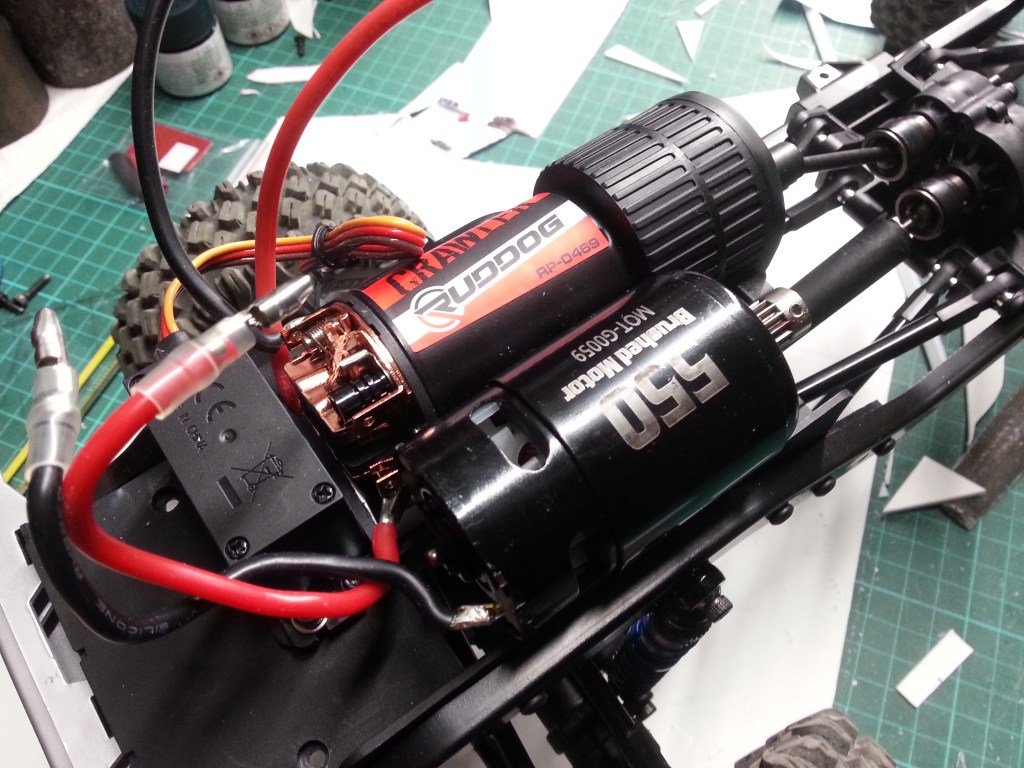
Schon rein äußerlich ist der betriebene Technikaufwand des verbauten Ruddog-Motors, im direkten Vergleich zum Baukastenmotor erkennbar.
Für ein einigermaßen, entspanntes Fahrvergnügen möchte ich noch ein weiteres Bauteil aufführen, die Federung. Von Stoßdämpfern habe ich jetzt bewusst nicht gesprochen. Eine Dämpfung ist trotz vorhandener Ölfüllung nicht vorhanden. Die Abstimmung der Feder ist FMS dabei aber gut gelungen, das muss ich schon zugeben. Die Viskosität der Ölfüllung, hat aber leider der schnellen Reaktion beim Ausfedern, nichts entgegenzusetzen. Einen Test das zu verbessern, habe ich aber nicht durchgeführt. In meinem Fundus befanden sich noch ein 70 mm langer Alu-Dämpfersatz von Team Raffee, für den es bisher keine Verwendung gab. Durch den hohen Schwerpunkt, ist ein starkes Wanken beim schnellen Ausfedern vorhanden, dass den Toyota blitzschnell auf die Seite legt. Dieses Phänomen konnte ich mit den TR-Dämpfern deutlich verbessern, aber leider noch nicht ganz abstellen. Die Optimierung muss an diesem Punkt von mir noch etwas angepasst werden. Einen Dämpferwechsel der nur 65 mm kurzen Originaldämpfer ist aber unbedingt erforderlich. Schon aus dem Grund, weil eine Fahrwerksstrebe vorzeitig an einem abstehenden Halter der optionalen Blattfederaufnahme in seinem Bewegungsraum eingeschränkt wird. Das ist ein Konstruktionsfehler, oder es wurde sich hier zu einfach gemacht. Dieses Phänomen ist aber leider auch bei anderen Herstellern zu beobachten…
Der Originaldämpfer mit Kunststoffgehäuse und linearer, einteiliger Feder. Den zweiten Dichtungsring und den Ölabstreifring habe ich nicht aus dem Gehäuse genommen, ist aber auch vorhanden.

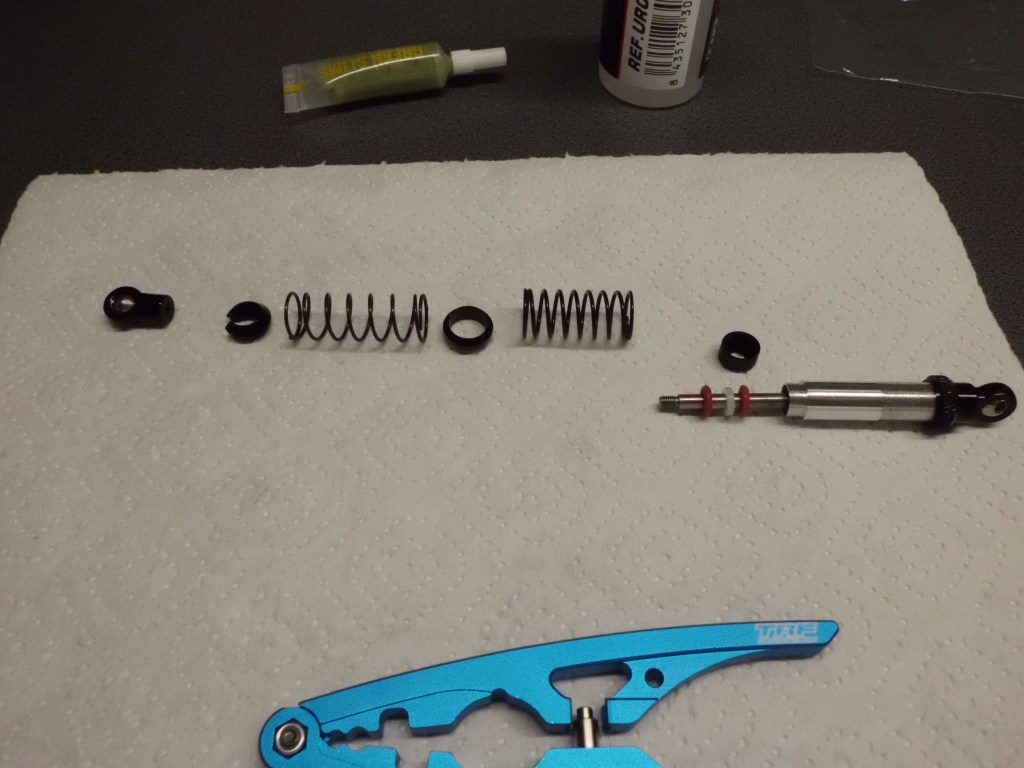
Ein TR-Dämpfer in seinen Bestandteilen. Alugehäuse, zweigeteilte Feder mit unterschiedlicher Kennlinie, Federbasis über ein Schraubgewinde einstellbar.
So ein Spielzeug für große Kinder, braucht halt manches Mal auch einfach solch herausragende Technik. Die blaue Feder hat hier keine optischen Gründe, sie dokumentiert eine andere Federhärte. Ich hatte es aber schon geschrieben, dieser Umbau ist wirklich notwendig!

Die Liste der Gegenüberstellungen wäre weiter fortsetzbar, aber irgendwie auch nicht weiter zielführend. Wollte ich doch nur die Frage Bausatz oder Fahrfertig (RtR=Ready to Run) gegenüberstellen. Mehr und noch besser geht immer. Das wird auch bei meinem Toyota so sein. So perfekt wie irgendwie möglich, aber ich will mich auch ohne weitere Umschweife festlegen. Was FMS hier zum aktuellen Preis von 379€ anbietet, ist optisch und auch technisch eine echte Glanzleistung. Ich versuche allerdings diese Glanzleistung mit weiterer Höchstleistung zu perfektionieren. In Kürze mehr davon!
Wird schnellstmöglich fortgesetzt…
English Version
RtR models recommended?
Sources:
In my last presentation of the Toyota FJ40, first impressions of the ready-to-drive model could be gathered. Many people may now be wondering about the advantages or disadvantages of a finished model. So far at least, I have only bought models as kits and then modified them more or less according to my own ideas. I see the advantage in using only durable parts that are as close as possible to my own ideas. Something that is only partially the case with a ready-to-run model. The comparison of price and performance will be a main focus. This applies to both manufacturers and customers. Using Toyota as an example, I will try to shed some light on this legitimate question.
In recent decades, the degree of miniaturization has developed considerably. At the same time, the resulting possibilities for creating realistic optics have reached the highest standards. Compared to my early days, the prices for remote control technology have fallen into price ranges that are affordable for everyone. So low that even the smallest models are equipped directly with a remote control. However, what they offer is not always in line with the expectations placed on them.
With crawlers, the focus is on driving slowly. Sensitive maneuvering and driving maneuvers are important for the overall enjoyment. The engine is important, but it is not the key point. The speed controller is of the utmost importance. The built-in WP-1040 speed controller is available here in Germany for around €20-30. The current reference model, the WP-1080, on the other hand, costs around €40-50. The price premium would therefore probably not be an issue for many model builders. If you also take into account the many optimization possibilities of the 1080, there should really be no more 1040s on the market! So why should it be? The two competitors are shown below. Above the WP-1040, below the WP-1080. From the outside, there are almost no major differences, apart from the round connectors (blue and yellow cable) fitted to the motor. When buying new, there are usually only open cable ends for self-assembly of the plug variant. Some even solder these cables directly to the contacts on the motor. This reduces the contact resistance to a minimum.
This part makes all the difference…
A programming card that is plugged into the speed controller. This allows 15 setting options (items) to be freely edited. In the background my currently selected configuration.
The first runs with the standard controller and motor looked like this. Pull the throttle slowly. For the first 5-10 mm, no recognizable reaction from the engine. After that, the car starts to move more or less strongly. The throttle response is borderline explosive. Sensitive driving thus resembles a game of chance, but is certainly possible. Provided the throttle is operated very sensitively. Without being able to compare it to a 1080, many would attest to the 1040’s impeccable performance. A justification for the 1040? My answer would be an undecided yes. I have driven many worse controllers, especially the standard controllers from Tamiya, which are controlled via a resistor. A 0-1/on-off control very reminiscent of digital technology. Few control characteristics in between, so not an ideal comparison. However, it represents the evolution of speed controller technology. Seen in this light, the 1040 is a small marvel of technology. Another advantage is that the 1040 can be put into operation immediately, but the permanent and shrill noise of the controller electronics is a real low point and absolutely annoying, at least to my ears. But before this comparison goes round in circles, I can conclude that the 1040 is justified, albeit not for me!
Another component is the motor. Inexpensive motors have always been available and fitted as standard. For example, the 35T motor already has a sufficient range to stop on steep ramps and also to start again, provided it has traction. However, the problem of sufficient traction applies to all motors, whether cheap or expensive. The smoother running and even more sensitive implementation of the voltage controlled by the speed controller can also be attributed to the motor quality. 5 stators and full ball bearings are the main differences to the standard motor. This additional cost is also noticeable and, for me, indispensable. The lower the overall resistance of the drive, the longer the ride time. But here too, depending on your requirements, a standard motor would also be acceptable.
Even from the outside, the technical effort put into the Ruddog engine is recognizable in direct comparison to the kit engine.
For a reasonably relaxed driving experience, I would like to mention another component, the suspension. I have deliberately not mentioned shock absorbers. Despite the oil filling, there is no damping. However, I have to admit that FMS has done a good job of tuning the springs. Unfortunately, the viscosity of the oil filling does nothing to counteract the fast reaction when the suspension is extended. However, I did not carry out a test to improve this. I still had a 70 mm long aluminum damper set from Team Raffee in my stash, which I hadn’t used before. Due to the high center of gravity, there is a strong roll during rapid rebound, which puts the Toyota on its side at lightning speed. I was able to significantly improve this phenomenon with the TR dampers, but unfortunately not yet completely eliminate it. I still have to make some adjustments to the optimization at this point. However, it is absolutely necessary to replace the original dampers, which are only 65 mm short. If only for the reason that a suspension strut is prematurely restricted in its range of movement by a protruding bracket of the optional leaf spring mount. This is a design error, or it was made too easy here. Unfortunately, this phenomenon can also be observed with other manufacturers…
The original damper with plastic housing and linear, one-piece spring. I did not remove the second sealing ring and the oil scraper ring from the housing, but they are also present.
The components of a TR damper. Aluminum housing, two-part spring with different characteristics, spring base adjustable via a screw thread.
Such a toy for big kids, sometimes simply needs such outstanding technology. The blue spring is not for visual reasons, it documents a different spring rate. But as I have already written, this conversion is really necessary!
The list of comparisons could go on and on, but somehow it’s not very useful. I just wanted to compare the question of kit or ready to run (RtR=Ready to Run). More and even better is always possible. That will also be the case with my Toyota. As perfect as possible, but I also want to commit myself without further ado. What FMS is offering here at the current price of €379 is a real tour de force, both visually and technically. However, I am trying to perfect this brilliant achievement with further top performance. More of this soon!
Will be continued as soon as possible…
Translation, with the kind support of deepl.com
 RC Crawler Modellbaublog